
Background jobs let a caller hand work to the platform and return immediately: enqueue an invocation over HTTP, get a jobId back at once, and let the queue run the function with retries, backoff, and a dead-letter queue — no Redis, no worker fleet, no polling loop to host.
Jobs run the same functions you deploy for HTTP traffic, with the same secrets, layers, and observability. The only difference is the trigger: a durable queue row instead of a live request.
Job lifecycle#
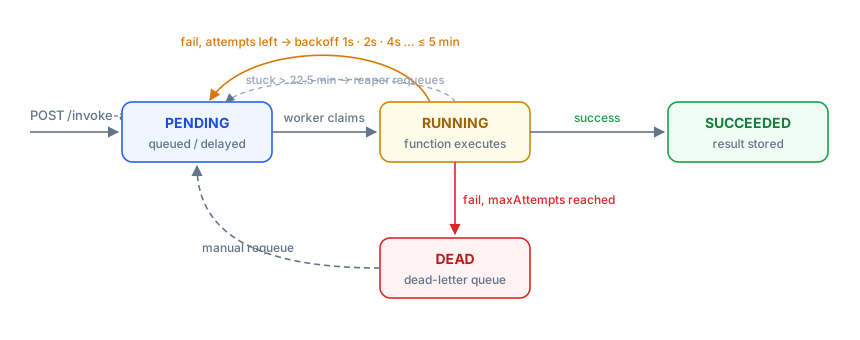
Every job moves through a small, explicit state machine. A worker claims PENDING jobs in batches, runs them as RUNNING, and records SUCCEEDED or schedules a retry on failure. When attempts are exhausted the job lands in DEAD — the dead-letter state — where you can inspect the error and requeue it manually.
Enqueue and poll#
Enqueue with one HTTP call — the response is 202 Accepted with the job id. Poll the job endpoint (or subscribe to run events in the console) to read the result:
# Enqueue: returns immediately with a job id (the function runs in the background)
curl -X POST "https://api.inquir.org/functions/{functionId}/invoke-async" \
  -H "Authorization: Bearer $INQUIR_API_KEY" \
  -H "Content-Type: application/json" \
  -d '{"event": {"orderId": "ord_123"}}'
# -> { "jobId": "…", "status": "PENDING" }

# Poll until the job reaches a terminal state
curl "https://api.inquir.org/jobs/{jobId}" \
  -H "Authorization: Bearer $INQUIR_API_KEY"
# -> { "status": "SUCCEEDED", "resultJson": … }  (or FAILED / DEAD with lastError)
Retries and backoff#
Retries are opt-in per enqueue: pass maxAttempts (up to 100) and failed attempts are re-queued with exponential backoff — 1 s, 2 s, 4 s and so on, capped at 5 minutes, with jitter to avoid thundering herds.
maxAttemptscounts the total attempts, not just retries, and a run lost with its worker counts too; the default is 1 (no retry).- While a job runs, its worker keeps renewing the job's lease, so a long job runs until its function's timeout instead of being cut off by the visibility timeout (22.5 min). The reaper steps in only when the lease stops being renewed — the worker crashed or became unreachable. It returns the job to the queue if attempts remain and dead-letters it if not, so a job that keeps killing its worker stops after
maxAttemptsruns. Write handlers so a second delivery is safe. - Delayed starts are supported via a schedule offset of up to 7 days — useful for reminders and cooldown windows.
Idempotency and concurrency control#
Two enqueue-time options keep duplicate work and stampedes out of your system:
idempotencyKey— enqueueing twice with the same key returns the original job instead of creating a duplicate (the response marks itdeduplicated).concurrencyKey+concurrencyLimit— cap how many jobs sharing a key run at once (per customer, per repository, per anything you choose).priority— higher-priority jobs are claimed first when the queue is deep.
Dead-letter queue#
When the last attempt fails, or its worker stops renewing the lease, the job becomes DEAD with its final error attached, and a terminal FAILED invocation is recorded for history. A lost lease reads reaped: visibility timeout; the worker stopped renewing the lease and no attempts remain. Dead jobs stay visible in the console: fix the cause, press requeue, and the job returns to PENDING with a fresh attempt budget.
Jobs vs durable instances vs pipelines#
Reach for a job when one function should run once in the background with retries and a dead-letter queue. Reach for a durable instance when you want that single run addressable by a stable id — an idempotent start and a pollable status (see Durable Functions). Reach for a graph pipeline when several functions form a workflow with branching, fan-out, a scheduled (cron) trigger, or a human-approval gate. All three share the same Postgres-backed queue underneath.